
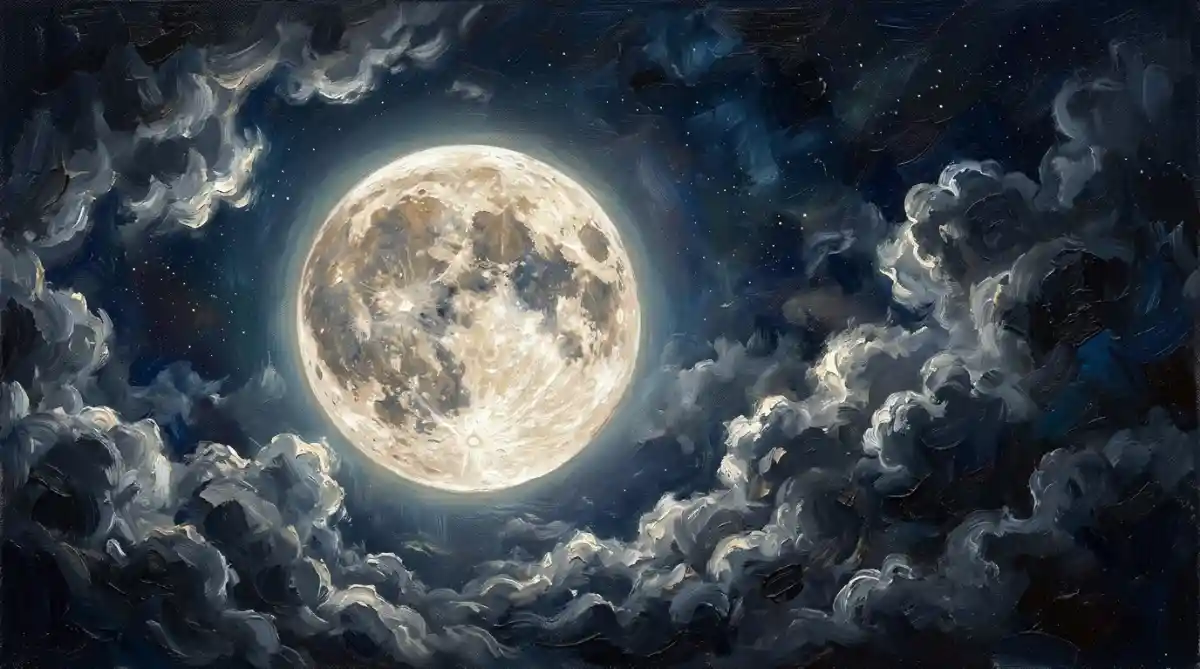
When is the Next Supermoon?
There are 8 supermoons in 2026 – 3 full and 5 new. The full supermoons fall on January 3, November 24, and December 24. The closest full supermoon of the year is December 24 at just 356,740 km. No supermoon is visible tonight unless you’re reading this on one of those dates. See the tables below for exact times and distances.
Full Supermoons of 2026
Here are the Full Supermoons of 2026, listed with their distances from Earth.
| Date | Traditional Name | Distance from Earth |
|---|---|---|
| January 3, 2026 | Wolf Moon | 225,130 miles (362,312 km) |
| November 24, 2026 | Beaver Moon | 224,170 miles (360,768 km) |
| December 24, 2026 | Cold Moon | 221,667 miles (256,740 km) |
- The December 24, 2026 Full Moon will be the closest Full Supermoon of the year.
New Supermoons of 2026
New moons aren’t visible to the naked eye, but they still count as supermoons under Richard Nolle’s original definition (any new or full moon near perigee). These five new supermoons complete the 2026 supermoon dates list.
| Date (UTC) | Distance from Earth |
|---|---|
| April 17, 2026 | 226,299 miles (364,194 km) |
| May 16, 2026 | 222,819 miles (358,594 km) |
| June 15, 2026 | 221,966 miles (357,221 km) |
| July, 14, 2026 | 223,789 miles (360,154 km) |
| August 12, 2026 | 228,017 miles (366,958 km) |
- The closest New Supermoon of 2026 occurs on June 15.
What is a Supermoon?
A supermoon is a full moon (or new moon) that coincides with the Moon reaching perigee – its closest point to Earth in its elliptical orbit. The term was coined by astrologer Richard Nolle in 1979, though “supermoon” isn’t an official astronomical term. Scientists prefer perigee-syzygy Moon.
Because the Moon is closer than usual, a full moon supermoon appears slightly larger and noticeably brighter than an average full moon. The perigee moon sits roughly 363,300 km from Earth on average, compared to about 405,500 km at its farthest.
Why does the Moon’s distance change?
The Moon does not orbit Earth in a perfect circle. Its distance varies by about 50,000 kilometers between apogee, the farthest point, and perigee, the closest point.
At perigee, the Moon is roughly 363,000 kilometers away. At apogee, it can be more than 405,000 kilometers distant. This changing distance is the reason we get supermoons and micromoons during different full Moons each year.
How much bigger does a Supermoon look?
Compared to an average full Moon, a supermoon can appear about 7 percent larger in diameter and up to 15 percent brighter.
To the naked eye, this difference is modest. Many people notice it most when comparing photos or when the Moon rises near buildings or trees. This visual trick, called the Moon illusion, can make the supermoon feel dramatic even though the size change is small.
Does a Supermoon affect Earth?
Supermoons slightly enhance ocean tides, producing what are known as perigean spring tides. These tides are higher than average but usually not extreme on their own.
They do not cause earthquakes, volcanic eruptions, or major disasters. Those claims have no scientific basis. That said, when a supermoon coincides with storms or high winds, coastal flooding can become more noticeable.
Supermoon vs micromoon
A micromoon is the opposite of a supermoon: a full or new moon that occurs near apogee, the Moon’s farthest point from Earth (~405,500 km). It appears roughly 12–14% smaller and noticeably dimmer than a full supermoon.
The angular diameter difference is real – about 0.5° vs 0.56° – but unless you’re comparing two images side by side, most observers won’t notice. The brightness gap is more obvious: a supermoon can be up to 30% brighter than a micromoon.
How to observe a supermoon
You don’t need a telescope to watch the supermoon. Here’s how to get the most out of it:
- Check your moonrise time. The best time to see a supermoon is right at moonrise or moonset, when it’s near the horizon. Use timeanddate.com or the USNO Moon data tool to find the exact time for your location.
- Get outside 10–15 minutes early. You want to catch the Moon as it clears the horizon – that’s when the horizon illusion makes it look its largest.
- Find a clear sightline. A hilltop, rooftop, or open field beats a street-level view blocked by buildings.
- Binoculars help. Even a basic 7×50 pair reveals craters and maria you’d miss with the naked eye.
- Escape light pollution. If you’re asking is there a super moon tonight from a city centre, you’ll still see it – but driving 20 minutes out of town makes a real difference in how bright and detailed it looks.
Supermoon astrophotography tips
Supermoon astrophotography rewards a bit of planning. Here’s what actually works:
- Use the “Looney 11” rule as a starting point. Set your aperture to f/11, ISO 100, and shutter speed 1/100 sec. Adjust from there – the Moon is brighter than most people expect.
- Include a foreground subject. A city skyline, a mountain ridge, or a lone tree makes the shot. Use PhotoPills or The Photographer’s Ephemeris to plan exactly where the Moon will rise relative to your chosen landmark.
- Shoot at moonrise or moonset. The low angle gives you that warm orange glow and a dramatic foreground. It also makes the Moon look bigger in the frame.
- Use a tripod and manual focus. Autofocus hunts in the dark. Focus on the Moon manually, set it to infinity, and lock it off.
- Bracket your exposures. Take shots at your base setting, then one stop brighter and one stop darker. The Moon’s brightness changes fast as it climbs.
- Phone cameras work. Modern iPhones and Android flagships can capture a decent supermoon shot. Lock the exposure by tapping and holding on the Moon in your viewfinder, then slide the exposure down. A phone tripod mount is worth the few euros it costs.
FAQ’s ❓
How many supermoons are there in 2026?
The year 2026 has 8 supermoons in total. There are 3 Full Supermoons and 5 New Supermoons!
Where did the term “supermoon” come from?
The word supermoon was coined in 1979 by astrologer Richard Nolle, who defined it as a new or full moon occurring within 90% of its closest approach to Earth. While the term originated outside professional astronomy, it has since become widely accepted in popular science and skywatching culture due to its simplicity and appeal.
Are supermoons rare?
Supermoons are not rare, but they are not frequent either. Their frequency depends on how closely perigee aligns with the Full or New Moon phase.
What is the difference between a supermoon and a regular full moon?
A supermoon is a full moon that occurs when the Moon is near its closest point to Earth (perigee). It appears up to 7% larger and 15% brighter than an average full moon, and up to 14% larger and 30% brighter than the faintest full moon of the year.
What is a micromoon?
A micromoon is a full moon that occurs near apogee, the Moon’s farthest point from Earth (~405,500 km). It looks about 12–14% smaller and dimmer than a supermoon. It’s the opposite of a supermoon.
How long does a supermoon last?
The Moon is technically at perigee for just a moment, but it looks noticeably larger and brighter for 2–3 nights around the peak date. The night of the exact full moon is best, but the nights before and after are nearly as good.
Can I photograph a supermoon with my phone?
Yes. Tap and hold on the Moon to lock focus and exposure, then drag the exposure slider down slightly. A small tripod or a steady surface makes a big difference. For the best results, shoot at moonrise when the Moon is low and orange.