
When is the next new moon?
The Next New Moon is on October 10, 2026, at 15:50 UTC.
There are 12 New Moons in 2026, with one occurring in each calendar month. The table below gives the exact dates and times of the New Moons in 2026.
Note: All dates and times on this page are in UTC unless otherwise stated.
New Moon Dates 2026
| Month | Date | Time (UTC) |
|---|---|---|
| January | January 18, 2026 | 19:52 |
| February | February 17, 2026 | 12:01 |
| March | March 19, 2026 | 01:23 |
| April | April 17, 2026 | 11:52 |
| May | May 16, 2026 | 20:01 |
| June | June 15, 2026 | 02:54 |
| July | July 14, 2026 | 09:43 |
| August | August 12, 2026 | 17:37 |
| September | September 11, 2026 | 03:27 |
| October | October 10, 2026 | 15:50 |
| November | November 9, 2026 | 07:02 |
| December | December 9, 2026 | 00:52 |
What is a new moon?
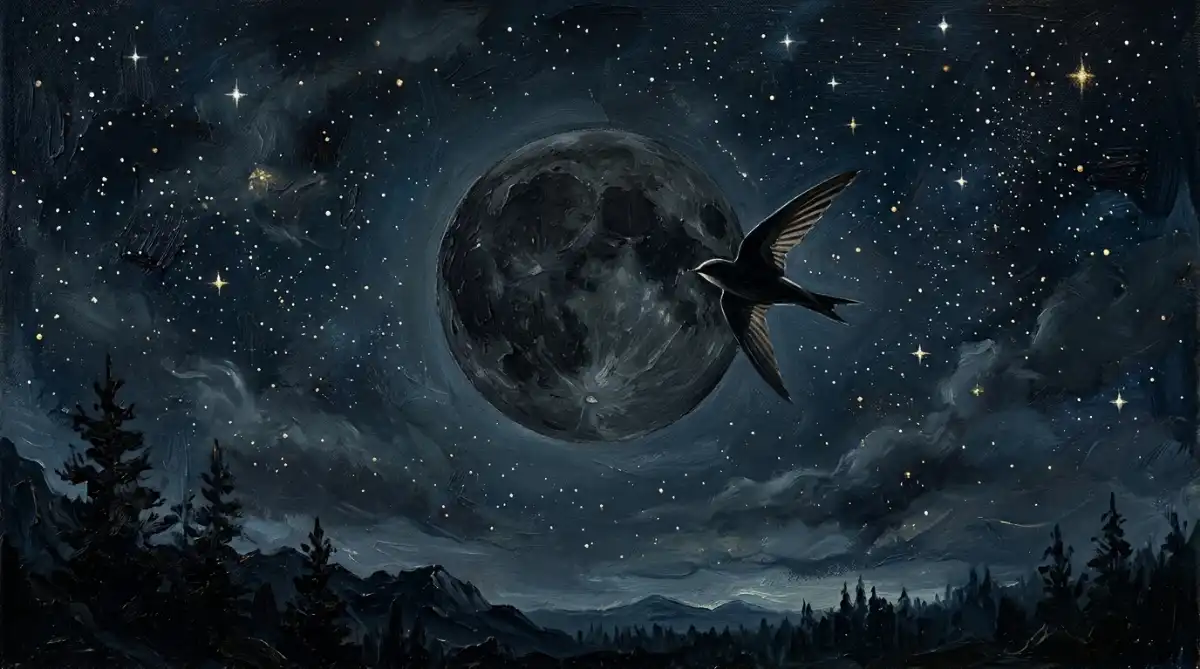
A New Moon marks the beginning of the lunar cycle. It occurs when the Moon is positioned between the Earth and the Sun, aligning in a way that the sunlit side faces away from our planet. As a result, the portion of the Moon visible from Earth remains in darkness, making it invisible to the naked eye.
The New Moon is also the starting point of a synodic month.
How often does a New Moon occur?
The average interval between two New Moons is about 29.53 days.
The average interval of about 29.53 days between successive New Moons is known as the synodic month. It is longer than the Moon’s orbital period relative to the distant stars because Earth is also moving around the Sun.
Twelve lunar cycles total only about 354 days, which is shorter than a Gregorian year. This difference causes lunar phases to fall on different calendar dates from year to year.
Most calendar years contain 12 New Moons. Occasionally, 13 can occur when the lunar cycle aligns in such a way that two fall within the same calendar month.
There are 12 New Moons in 2026.
can you see a New Moon with naked eye?
We can’t see a new moon because The side of the Moon facing Earth is mostly unilluminated. and The Moon is close to the Sun in the daytime sky, making it difficult to observe even with optical equipment.
As the Moon moves farther east of the Sun after this phase, a small illuminated crescent gradually becomes visible after sunset.
That first visible crescent is not the New Moon itself. It is the waxing crescent phase that follows it.
the lunar cycle
The Moon passes continuously through a cycle of phases as its position changes relative to Earth and the Sun.
The sequence is:
New Moon → Waxing Crescent → First Quarter → Waxing Gibbous → Full Moon → Waning Gibbous → Last Quarter → Waning Crescent → New Moon
New Moon and Full Moon are approximately half a lunar cycle apart, or about two weeks.
Why is the New Moon good for stargazing?
New Moon is particularly useful for observing faint objects because there is little or no moonlight brightening the nighttime sky.
This makes dark-sky conditions better for observing:
- Galaxies
- Nebulae
- Star clusters
- The Milky Way
- Faint stars
However, the absence of moonlight does not automatically mean perfect observing conditions. Artificial light, clouds, haze and atmospheric transparency can have an even greater effect.
For the darkest skies, choose a location away from cities and check the weather before heading out.
New Moon and solar eclipses
A solar eclipse can only occur during a New Moon, but most New Moons do not produce an eclipse.
The Moon’s orbit is tilted by about 5° relative to Earth’s orbit around the Sun. As a result, the Moon usually passes slightly above or below the Sun from our perspective.
An eclipse requires a much more precise alignment.
In 2026, two New Moons coincide with solar eclipses:
- February 17: Annular solar eclipse
- August 12: Total solar eclipse
So while every solar eclipse happens at New Moon, only a small fraction of New Moons result in an eclipse.
New Moon and tides
The Sun and Moon both exert gravitational forces on Earth’s oceans. Around New Moon and Full Moon, these forces work together to produce a larger tidal range known as a spring tide.
Despite the name, spring tides are not related to the spring season.
The actual height of a tide depends on local geography, coastline shape, ocean depth and weather conditions, so the lunar phase alone does not determine how high a particular tide will be.
New Moon vs Full Moon
New moon and the Full moon are the opposite primary phases of the lunar cycle.
| Comparison point | New Moon | Full Moon |
|---|---|---|
| Position | Moon is approximately between Earth and Sun | Earth is approximately between Sun and Moon |
| Illuminated side | Mostly faces away from Earth | Faces Earth |
| Appearance | Normally invisible | Nearly fully illuminated |
| Nighttime moonlight | Minimal | Maximum |
| Best for | Dark-sky observing | Lunar observing |
If your goal is to observe the Moon’s surface, the Full Moon is much easier to see. If you want darker skies for galaxies, nebulae or Milky Way photography, the period around New Moon is generally more useful.
Super New Moons
The Moon’s orbit around Earth is elliptical, so its distance from Earth changes throughout the month.
A New Moon occurring near the Moon’s closest approach, or perigee, can be described as a Super New Moon.
There are five New Supermoons in 2026:
| Date | Time (UTC) | Type |
|---|---|---|
| April 17, 2026 | 11:52 | New Supermoon |
| May 16, 2026 | 20:01 | New Supermoon |
| June 15, 2026 | 02:54 | New Supermoon |
| July 14, 2026 | 09:43 | New Supermoon |
| August 12, 2026 | 17:37 | New Supermoon |
Because the Moon is essentially invisible at this phase, a Super New Moon does not appear visibly larger in the sky. Its significance is primarily its orbital distance from Earth.
Black Moon
A Black Moon is an informal term sometimes used for the second New Moon in a calendar month.
There is no Black Moon in 2026 because every month contains only one New Moon.
FAQ’s ❓
When is the next New Moon?
See the New Moon Calendar above to know the next new moon date.
How many New Moons are there in 2026?
There are 12 New Moons in 2026, with one occurring in each calendar month.
What happens during a New Moon?
During a New Moon the Moon reaches the point in its orbit where it is approximately between Earth and the Sun. The illuminated half faces mostly away from Earth, so the Moon is normally invisible.
Can you see a New Moon with the naked eye?
We normally can’t see a New Moon because the side facing Earth is mostly unilluminated. The Moon is also close to the Sun in the daytime sky, making it extremely difficult to observe.
When can you see the Moon after New Moon?
A thin waxing crescent may become visible after sunset roughly a day or two later, although visibility depends strongly on location and atmospheric conditions.
Why is New Moon good for stargazing?
There is little or no moonlight in the nighttime sky during a New Moon, giving faint celestial objects better contrast against the darkness.
Does every New Moon cause a solar eclipse?
No. A solar eclipse requires the Sun, Moon and Earth to be aligned closely enough for the Moon’s shadow to reach Earth.
How many Super New Moons are there in 2026?
There are five Super New Moons in 2026: April 17, May 16, June 15, July 14 and August 12.
Is there a Black Moon in 2026?
No, there is no Black Moon in 2026.
What is the difference between New Moon and Full Moon?
At New Moon, the illuminated side of the Moon faces mostly away from Earth. At Full Moon, the illuminated side faces Earth, making the lunar disk appear nearly completely bright.
How often does the lunar cycle repeat?
The average interval from one New Moon to the next is about 29.53 days.