
How much would I weigh on the moon?
The Moon’s gravity is only about 16.5% of Earth’s, which means everything weighs much less on the lunar surface. Enter your weight in the calculator below to instantly know your Moon weight.
Why is gravity weaker on the moon?
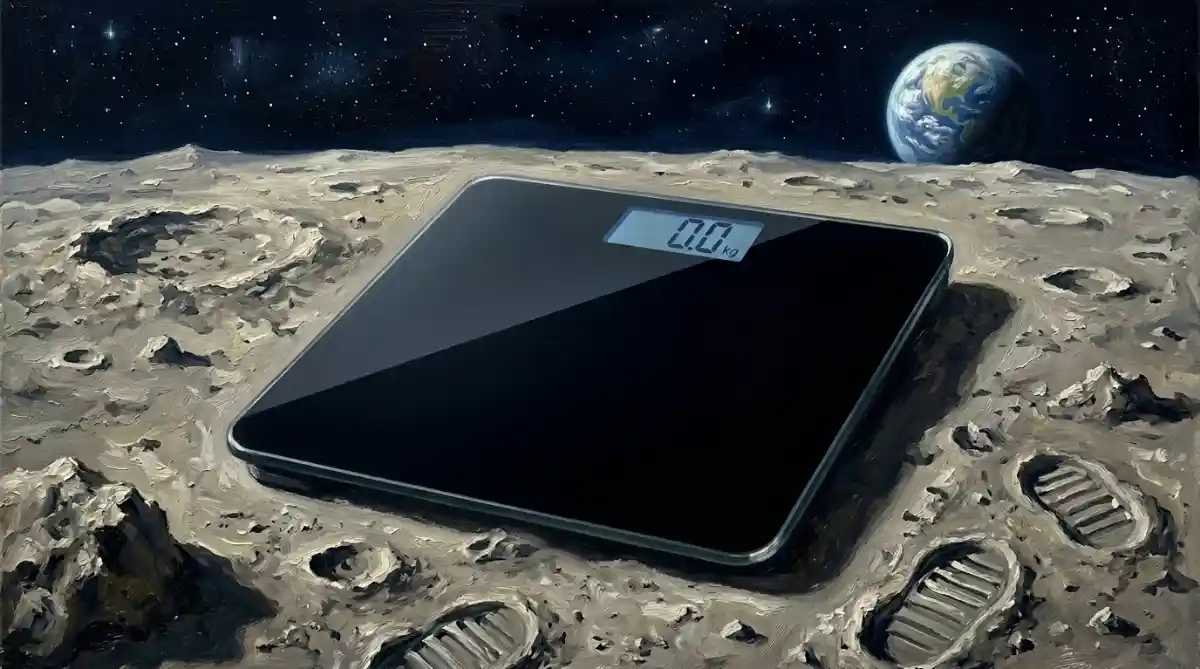
The Moon’s gravity is weaker than Earth’s because gravitational force depends on two things: mass and radius. The Moon has only 1.23% of Earth’s mass (7.35 × 10²² kg, compared to Earth’s 5.97 × 10²⁴ kg) and roughly 27% of Earth’s radius.
Using Newton’s Law of Universal Gravitation: F = G(m₁m₂/r²), the Moon’s surface gravity works out to approximately 1.625 m/s², compared to Earth’s 9.807 m/s². That is about 16.5% of Earth’s gravitational pull.
In practice, this means a person who weighs 70 kg on Earth would weigh approximately 11.6 kg on the Moon. They would be the same mass (mass never changes) but their weight, which is the force of gravity acting on that mass, would be dramatically reduced.
This lower gravity is why Apollo astronauts could make those iconic bounding leaps across the lunar surface, even while wearing a 90 kg spacesuit that would be impossible to move in on Earth.
Difference between mass and weight
Mass is the amount of matter in an object, it never changes regardless of where you are. Whether you’re on Earth, the Moon, or floating in deep space, your mass stays the same.
Weight is the force that gravity exerts on that mass. It’s calculated as mass × gravitational acceleration (W = mg), so it changes depending on where you are. On the Moon, where gravity is about 1/6th of Earth’s, you weigh about 1/6th as much but your mass is identical.
A simple way to remember it: mass is what you’re made of, weight is how hard gravity is pulling on you. A 70 kg person has a mass of 70 kg everywhere in the universe, but weighs about 686 Newtons on Earth and only about 113 Newtons on the Moon.
The units give it away too, mass is measured in kilograms (kg), while weight is technically measured in Newtons (N). In everyday life we use “kg” loosely for both, which is where the confusion comes from.
Interesting facts about moon’s gravity
- You could jump six times higher on the Moon. On Earth, the average person can jump about 0.5 metres vertically. On the Moon, that same effort would take you over 3 metres off the ground.
- An elephant on the Moon would weigh less than a person on Earth. An adult African elephant weighs around 6,000 kg on Earth. On the Moon, it would weigh just under 1,000 kg (lighter than a typical car on Earth).
- The Moon’s gravity still affects Earth from 384,000 km away. Despite its low surface gravity, the Moon’s gravitational pull is strong enough to cause Earth’s ocean tides one of the most powerful forces shaping life on our planet. Learn more about how the Moon’s phase relates to tidal strength on our Moon Phase Today page.
- Walking on the Moon burns fewer calories. Because your effective weight is lower, your muscles do less work against gravity. Astronauts found that even in bulky suits, movement on the Moon felt surprisingly effortless once they adapted.
- You would age slightly faster on the Moon. According to general relativity, weaker gravity slightly slows the curvature of spacetime. Clocks on the Moon tick a tiny fraction faster than clocks on Earth (about 56 microseconds per day faster).
FAQ’s ❓
How much would a 60 kg person weigh on the moon?
A person who weighs 60 kg on Earth would weigh approximately 9.9 kg on the Moon. The Moon’s gravity is 16.5% of Earth’s, so multiply your Earth weight by 0.165 to get your Moon weight.
How much would a 70 kg person weigh on the moon?
A 70 kg person on Earth would weigh approximately 11.6 kg on the Moon.
How much would a 80 kg person weigh on the moon?
A person weighing 80 kg on Earth would weigh approximately 13.2 kg on the Moon.
Does your mass change on the moon?
No. Mass is the amount of matter in your body and never changes, regardless of where you are in the universe. Weight, however, changes because it is the force of gravity acting on your mass. On the Moon, you have the same mass but less weight.
Why is gravity weaker on the moon?
The Moon’s gravity is weaker primarily because it has much less mass than Earth, only about 1.23% of Earth’s mass. Since gravitational force depends on mass, a smaller mass produces a weaker gravitational field at the surface.
Could you lift a car on the moon?
In theory, yes. An average car weighs about 1,400 kg on Earth, but on the Moon it would weigh only about 231 kg comparable to lifting a large motorcycle on Earth. Whether you could actually lift it would still depend on your strength and the mechanics involved.
How does the moon’s gravity affect earth?
The Moon’s gravity is primarily responsible for Earth’s ocean tides. As the Moon orbits Earth, its gravitational pull creates a slight bulge in the oceans on the side of Earth facing the Moon. This produces the regular pattern of high and low tides we experience each day.
Is there any gravity on the moon?
Yes. The Moon has about 16.5% of Earth’s surface gravity. There is no such thing as “zero gravity” on the surface of any large body.
Could I jump higher on the Moon?
Yes. Because lunar gravity is much weaker than Earth’s, you would accelerate downward more slowly after jumping.
How is Moon weight calculated?
Your lunar weight is calculated by multiplying your Earth weight by the ratio of lunar gravity to Earth’s gravity. The Moon’s surface gravity is approximately 1.62 m/s², compared with about 9.81 m/s² on Earth.