
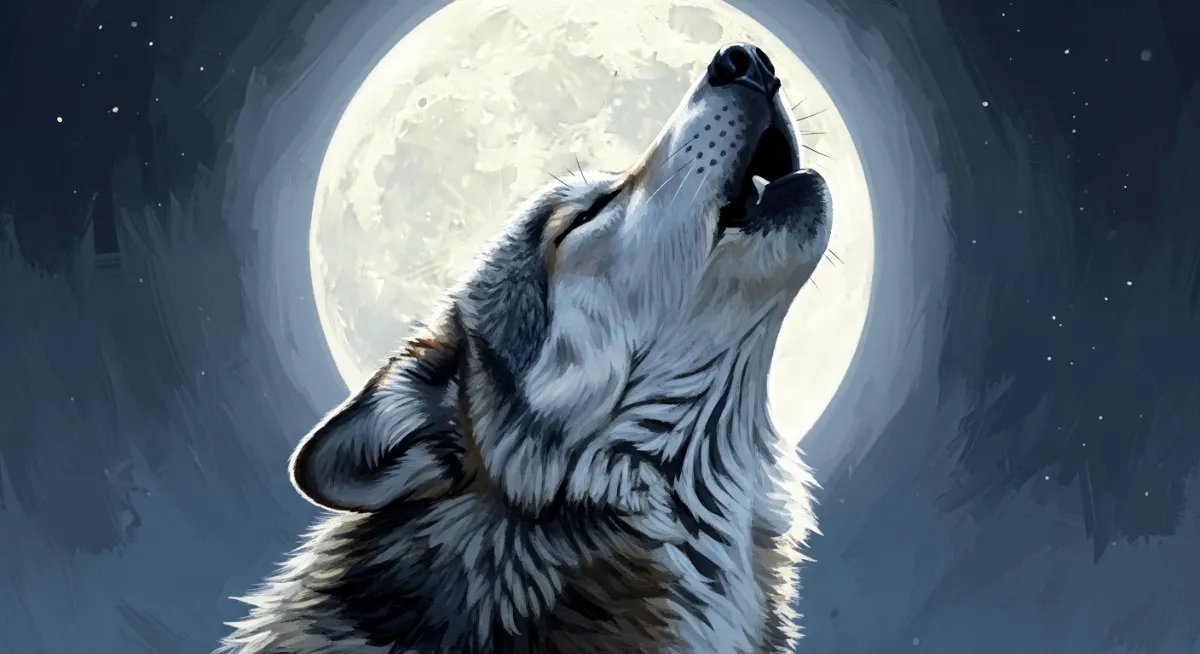
Quick Facts about the Wolf Moon
- Wolf Moon Date: Saturday, January 3, 2026
- Peak illumination: 10:03 UTC
- Traditional Name: Wolf Moon
- Named After: The howling of wolves during the cold January nights
- Moon Sign: Cancer
- Best viewing: Around 30 minutes after sunset, with a clear horizon toward the east.
- Other names: Ice Moon, Old Moon, Moon After Yule, Quiet Moon, Snow Moon
The January full moon is traditionally known as the Wolf Moon, a name associated with wolves being more active and heard during the cold winter nights. In 2026, the Wolf Moon reaches peak illumination on January 3 at 10:03 UTC. It is also a supermoon, occurring close to the moon’s perigee, which makes it appear slightly larger and brighter than an average full moon.
For upcoming Full Moon dates, see the Full Moon Calendar.
When is the Wolf Moon 2026?
The Wolf Moon reaches full phase on Saturday, January 3, 2026, at 10:03 UTC.
In India, the Full Moon reaches peak illumination at approximately 3:33 PM IST on January 3. Since the exact peak occurs during daylight hours, observers in India will see the Moon as essentially full after sunset on January 3.
The Moon will also appear nearly full on the evening before the peak, making both January 2 and January 3 good nights for observation.
You can check the Moon’s exact details for January 3, including illumination, Moon age, distance from Earth, azimuth, and other lunar data, on Moon Age Today.
Why Is It Called the Wolf Moon?
The name Wolf Moon is traditionally associated with wolves being heard howling during the cold and snowy nights of January.
The name appears in North American full moon naming traditions and became widely used through modern calendars and almanacs. The association with wolves reflects the seasonal conditions of midwinter rather than any astronomical effect caused by the Moon.
The January Full Moon has several other traditional names that describe winter conditions, cold weather, and the start of the new year.
How to watch the Wolf Moon
The Wolf Moon is bright enough to observe without any special equipment.
- Find a location with a clear view toward the eastern horizon.
- Look shortly after sunset as the Moon rises.
- Choose a location away from tall buildings, trees, and other obstructions.
- Binoculars can reveal craters and other lunar surface features.
- A telescope provides a closer view of the lunar surface.
- For photography, use trees, buildings, or mountains in the foreground to create scale.
For exact local moonrise and moonset times, use the Moonrise & Moonset Time Calculator.
Why is the January full moon a supermoon?
The January 2026 Wolf Moon is a supermoon because the full moon occurs close to the moon’s perigee, the point where the moon is closest to Earth during its elliptical orbit.
Because of this proximity, the Moon appears slightly larger and brighter than a full moon occurring farther from Earth.
The difference is relatively small and is difficult to notice with the naked eye. The effect becomes easier to appreciate when comparing photographs of full moons taken at different distances from Earth.
What is a supermoon?
A supermoon occurs when a full moon or new moon happens close to perigee.
The Moon’s orbit around Earth is elliptical rather than perfectly circular, so its distance from Earth changes throughout the month. When a Full Moon occurs near perigee, the lunar disk appears somewhat larger and brighter than when a Full Moon occurs farther away.
The term “supermoon” is not a formal scientific classification. Astronomers generally describe these events in terms of perigee and the full moon’s distance from Earth.
For upcoming supermoon dates, see the Supermoon Calendar.
Other Traditional Names of the January Full Moon
The January Full Moon has several traditional names connected with winter and the beginning of the year.
- Ice Moon: Associated with freezing temperatures and winter ice.
- Old Moon: Refers to the old year and the continuing winter season.
- Moon After Yule: Used in some European traditions for the full moon following the Christmas period.
- Quiet Moon: Associated with the stillness of winter.
- Snow Moon: Refers to winter snowfall.
- Winter Moon: A general seasonal name connected with the coldest part of the year.
These names come from different cultural and regional traditions and were not used universally.
Lunar Eclipse Details (If any)
There is no lunar eclipse during the January 2026 Wolf Moon.
The January Full Moon does not pass through Earth’s shadow, so no lunar eclipse occurs during the event.
The first lunar eclipse of 2026 occurs on March 3, when the Worm Moon becomes a total lunar eclipse.
You can track upcoming lunar eclipses with the Lunar Eclipse Calendar.
Moon Phases for January 2026
| Phase | Date |
|---|---|
| Full Moon 🌕 | January 3 |
| Last Quarter 🌗 | January 10 |
| New Moon 🌑 | January 18 |
| First Quarter 🌓 | January 26 |
The Full Moon occurs on January 3 at approximately 10:03 UTC, the last quarter on January 10 at approximately 15:48 UTC, the new moon on January 18 at approximately 19:52 UTC, and the first quarter on January 26 at approximately 04:48 UTC.
To follow the moon’s daily phases throughout January, use the Moon Phase Calendar.
Other Must-Watch Sky events in January 2026
- Quadrantid Meteor Shower, January 3 to 4: The Quadrantids reach their annual peak around January 3 to 4. The shower can produce a short but strong burst of meteors under dark skies.
- Wolf Moon, January 3: The January Full Moon reaches peak illumination at 10:03 UTC and occurs close to lunar perigee, making it a supermoon.
- Moon and Spica, January 7: The waning gibbous Moon passes close to Spica, the brightest star in Virgo.
- Moon and Antares, January 11: The waning Moon passes close to Antares in Scorpius during the morning sky.
- New Moon, January 18: The New Moon creates dark skies that are favorable for observing faint stars and deep-sky objects.
- Moon and Venus, January 20: A thin crescent Moon appears near bright Venus shortly after sunset.
- Moon and Saturn, January 21: The young crescent Moon passes close to Saturn in the evening sky.
- Moon and Jupiter, January 26: The First Quarter Moon passes close to Jupiter, creating a bright pairing visible in the evening sky.
- Moon and Pleiades, January 28: The Moon passes near the Pleiades star cluster, also known as M45.
Leave a Reply