
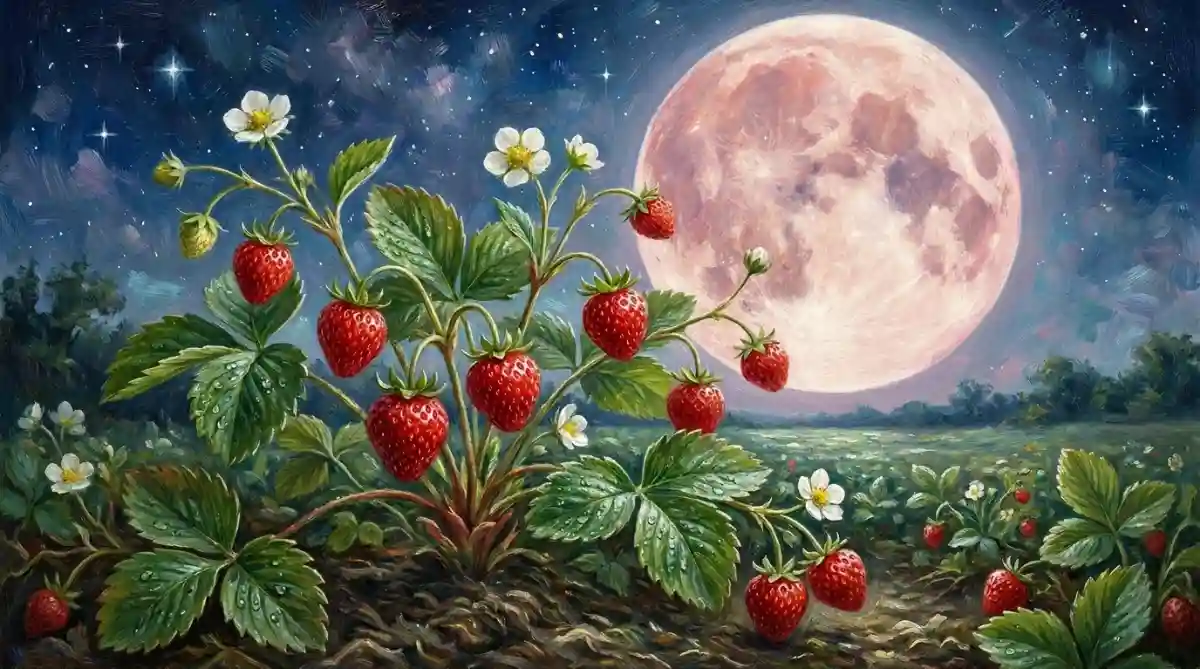
Quick Facts about the Strawberry Moon
- Strawberry Moon Date: Monday, June 29, 2026
- Peak illumination: 23:57 UTC
- Traditional Name: Strawberry Moon
- Named After: The seasonal ripening and harvesting of strawberries
- Moon Sign: Capricorn
- Best viewing: Around 30 minutes after sunset, with a clear horizon toward the southeast.
- Other names: Rose Moon, Hot Moon, Mead Moon, Honey Moon, Berries Ripen Moon, Green Corn Moon
The June Full Moon is traditionally known as the Strawberry Moon. In 2026, it reaches peak illumination on June 29 at 23:57 UTC. The name is associated with the seasonal strawberry harvest in parts of North America. The 2026 Strawberry Moon is also notable for its low path across the sky for observers in the Northern Hemisphere because it occurs shortly after the June solstice.
For upcoming Full Moon dates, see the Full Moon Calendar.
When is the Strawberry Moon in 2026?
The Strawberry Moon reaches full phase on Monday, June 29, 2026, at 23:57 UTC.
The exact local date depends on your time zone. In parts of Asia, including India, the peak occurs after midnight on June 30 local time.
The Moon can still appear essentially full on the nights immediately before and after the exact peak.
You can check the Moon’s exact details for June 29, including illumination, Moon age, distance from Earth, azimuth, and other lunar data, on Moon Age Today.
Why Is It Called the Strawberry Moon?
The name Strawberry Moon comes from the seasonal strawberry harvest traditionally associated with June in parts of North America.
The name is commonly associated with Indigenous traditions recorded in North American sources, particularly those connected with the Algonquin peoples. The Old Farmer’s Almanac popularized the name in modern full moon calendars.
The Strawberry Moon does not turn pink or red because of its name. The name refers to the strawberry season rather than the Moon’s color.
Different cultures have used different names for the June Full Moon based on local plants, crops, weather, and seasonal activities.
How to watch the Strawberry Moon
The Strawberry Moon is bright enough to see without a telescope.
- Find a location with a clear view toward the eastern or southeastern horizon.
- Look shortly after sunset as the full moon rises.
- Choose a location away from tall buildings, trees, and hills.
- Binoculars can reveal craters and other lunar surface features.
- Use a camera or smartphone to photograph the Moon near the horizon.
- Include trees, buildings, or mountains in the foreground for scale.
For exact local moonrise and moonset times, use the Moonrise & Moonset Time Calculator.
Why is the June Full Moon so low in the sky?
The 2026 Strawberry Moon follows the June solstice by only a few days. Around the solstice, the Sun reaches its highest declination in the Northern Hemisphere, while the Full Moon is positioned near the opposite side of the sky.
As a result, the Full Moon follows a relatively low path across the northern sky for observers in the Northern Hemisphere. The effect is reversed in the Southern Hemisphere, where the June Full Moon travels much higher across the sky.
This makes the 2026 Strawberry Moon particularly interesting for photographers and skywatchers at northern latitudes.
Why can the Strawberry Moon look orange?
The Strawberry Moon can appear yellow, orange, or reddish when it is close to the horizon.
Moonlight travels through a greater thickness of Earth’s atmosphere when the Moon is low in the sky. Atmospheric scattering removes more of the shorter blue wavelengths from the direct path of the light, leaving warmer colors more noticeable.
Dust, smoke, haze, and other particles in the atmosphere can strengthen the effect.
Other Traditional Names of the June Full Moon
The June Full Moon has several traditional names connected with seasonal changes and natural events.
- Rose Moon: Associated with blooming roses in parts of Europe.
- Hot Moon: Refers to the warmer conditions of early summer.
- Mead Moon: Connected with the production or drinking of mead.
- Honey Moon: Associated with honey production and the traditional June wedding season.
- Berries Ripen Moon: Refers to berries becoming ripe during June.
- Green Corn Moon: Associated with young corn crops.
- Flower Moon: Used in some traditions for the period when many plants are flowering.
These names come from different cultures and regions and were not used universally.
Lunar Eclipse
There is no lunar eclipse during the June 2026 Strawberry Moon.
You can track upcoming lunar eclipses with the Lunar Eclipse Calendar.
Moon Phases for June 2026
| Phase | Date |
|---|---|
| Last Quarter 🌗 | June 8 |
| New Moon 🌑 | June 15 |
| First Quarter 🌓 | June 21 |
| Full Moon 🌕 | June 29 |
The Last Quarter occurs on June 8 at approximately 10:00 UTC, the New Moon on June 15 at approximately 02:54 UTC, the First Quarter on June 21 at approximately 21:55 UTC, and the Full Moon on June 29 at approximately 23:57 UTC.
To follow the moon’s daily phases throughout June, use the Moon Phase Calendar.
Other Must-Watch Sky events in June 2026
- Venus and Jupiter conjunction, June 9: Venus and Jupiter appear close together in the evening sky. Both are bright enough to see without optical equipment.
- Moon and Saturn, June 10: The Moon passes close to Saturn, creating a notable pairing in the morning sky.
- Mercury at greatest elongation, June 15: Mercury reaches its greatest eastern elongation, giving observers a favorable opportunity to find the planet after sunset.
- Moon, Mercury, Venus, and Jupiter, June 16 to 18: The Moon joins Mercury, Venus, and Jupiter in a striking grouping around the evening sky.
- June Solstice, June 21: The June solstice occurs at approximately 08:24 UTC, marking the beginning of astronomical summer in the Northern Hemisphere and winter in the Southern Hemisphere.
- Moon and Antares, June 27: The Moon passes close to Antares, the bright red supergiant star in Scorpius.
- Strawberry Moon, June 29: The Full Moon reaches peak illumination at 23:57 UTC and becomes the June Full Moon of 2026.
Sources
- NASA: June 2026 Skywatching Guide
- NASA SkyCal: 2026 Sky Events
- Time and date: Skywatching in June 2026
- EarthSky: June Full Moon 2026
Note: All dates and times in this article are given in UTC unless otherwise stated. Local moonrise, moonset, and visibility vary by location.

Leave a Reply