
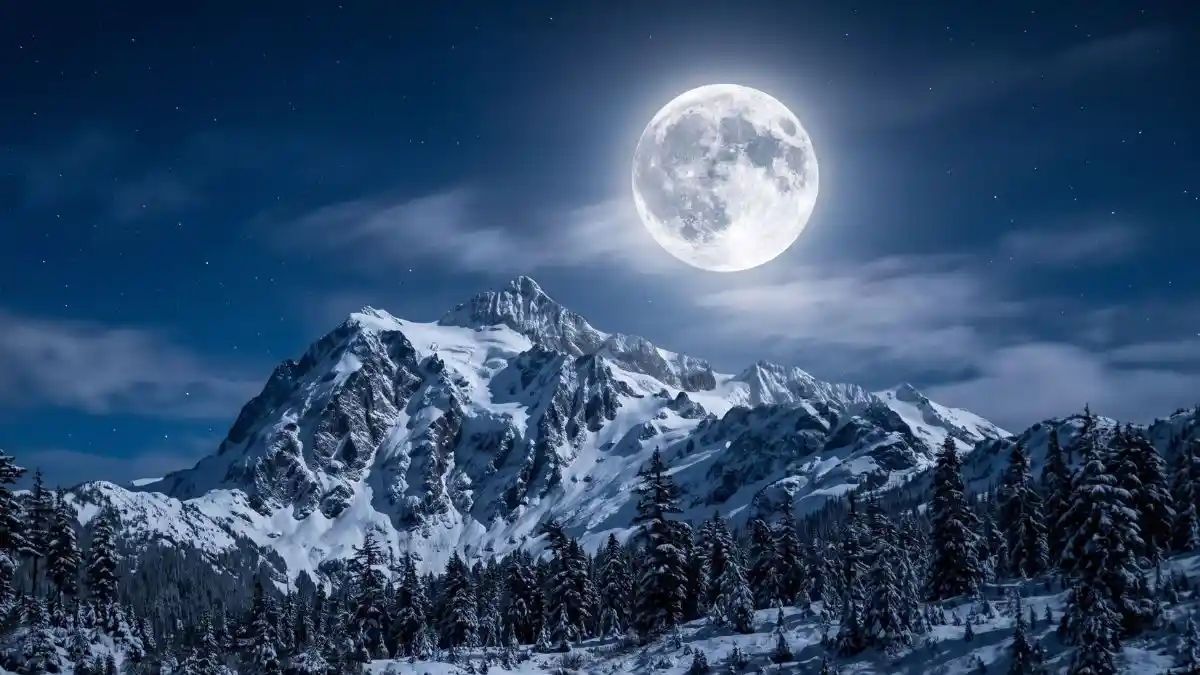
Quick Facts about the Cold Moon
- Cold Moon Date: December 24, 2026 (UTC)
- Peak illumination: 01:28 UTC
- Traditional Name: Cold Moon
- Named After: The cold temperatures of early winter in the Northern Hemisphere
- Astrological Moon Sign: Cancer
- Best viewing: The evening of December 23 or 24, depending on your location
- Other names: Long Night Moon, Moon Before Yule, Winter Moon, Snow Moon, Oak Moon
The December full moon is traditionally called the “cold moon,” a name associated with the arrival of winter and falling temperatures in the Northern Hemisphere. In 2026, it reaches peak illumination at 01:28 UTC on December 24. It is also the closest full moon to Earth in 2026, making it the year’s closest supermoon. In North American time zones, the peak occurs on the evening of December 23. (The Old Farmer’s Almanac, NASA SkyCal)
For the dates of every full moon in 2026, see our Full Moon Calendar.
When Is the Cold Moon 2026?
The Cold Moon reaches peak illumination on Thursday, December 24, 2026, at 01:28 UTC. In India, this occurs at 6:58 AM IST on December 24.
The moon will appear nearly full on the evenings before and after the exact peak. In India, the evening of December 23 offers a good opportunity to watch it rise, while observers in North America can see it around moonrise on December 23.
A full moon occurs when the moon lies opposite the sun in Earth’s sky. Sunlight illuminates the lunar hemisphere facing Earth, making the disk appear fully lit.
You can check the Moon’s illumination, age, distance from Earth, azimuth, and other details for any date on Moon Age Today.
Why Is It Called the Cold Moon?
The name Cold Moon reflects the cold weather that traditionally arrives in December across much of the Northern Hemisphere. The name is commonly associated with Native North American lunar naming traditions.
December also brings the winter solstice, the shortest day and longest night of the year in the Northern Hemisphere. The Cold Moon occurs just a few days after the solstice in 2026.
The name describes the season rather than a physical change in the moon. Other traditional names also refer to long nights, frost, snow, and winter celebrations.
How to Watch the Cold Moon
You do not need a telescope to see the full moon. Find a location with a clear view of the horizon and watch as the moon rises around sunset.
When the Moon is close to the horizon, it may appear orange or yellow. Earth’s atmosphere scatters shorter wavelengths of light, allowing more reddish and yellow light to reach your eyes. The moon can also appear larger near the horizon because of the moon illusion, a visual effect rather than a change in its actual size.
For local Moonrise and Moonset times, use our Moonrise and Moonset Time Calculator.
Is the Cold Moon a Supermoon?
Yes, the December 2026 Cold Moon is a supermoon. It occurs close to perigee, the point in the Moon’s elliptical orbit when it is nearest to Earth.
The Moon reaches perigee on December 24 at approximately 08:29 UTC, about seven hours after the Full Moon. Its distance from Earth at perigee is approximately 356,650 km.
Because it is so close to Earth, the Cold Moon can appear slightly larger and brighter than a typical full moon. The difference is subtle to the naked eye, although the Moon can look especially striking as it rises near the horizon.
Other Traditional Names of the December Full Moon
Different cultures have used names for the December Full Moon that reflect seasonal weather, long nights, and winter traditions.
- Long Night Moon: Refers to the long nights around the winter solstice.
- Moon Before Yule: Connects the Full Moon with the traditional midwinter festival of Yule.
- Winter Moon: Reflects the beginning of winter in the Northern Hemisphere.
- Snow Moon: Used in some traditional naming lists to describe winter conditions.
- Oak Moon: A name associated with European seasonal traditions.
Traditional moon names vary by culture and historical source. The Cold Moon and Long Night Moon are among the best-known names associated with December.
Lunar Eclipse Details
There is no lunar eclipse during the December 2026 full moon.
A lunar eclipse occurs when the full moon passes through Earth’s shadow. Although every lunar eclipse happens during a full moon, not every full moon produces an eclipse because the Moon’s orbit is tilted relative to Earth’s orbital plane.
For upcoming lunar eclipses, dates, and visibility information, see our Lunar Eclipse Calendar.
Moon Phases for December 2026
| Moon Phase | Date | Time (UTC) |
|---|---|---|
| Last Quarter 🌗 | December 1 | 06:09 |
| New Moon 🌑 | December 9 | 00:52 |
| First Quarter 🌓 | December 17 | 05:43 |
| Full Moon 🌕 | December 24 | 01:28 |
| Last Quarter 🌗 | December 30 | 18:59 |
December has two last-quarter moons, one at the beginning and one near the end of the month. The Full Moon occurs on December 24 in UTC, although some local calendars list December 23 because of time-zone differences.
See our Moon Phase Calendar for daily lunar phases throughout 2026.
Other Must-Watch Sky Events in December 2026
- December 3: The Moon passes near Spica, the brightest star in Virgo. Look toward the morning sky for the pairing.
- December 13–14: The Geminid meteor shower reaches its peak. It is one of the year’s strongest annual meteor showers, with the best viewing generally after midnight under dark skies.
- December 17: The Moon reaches First Quarter. Its half-lit disk is a good target for binoculars or a small telescope because the terminator, the boundary between lunar day and night, highlights craters and mountains.
- December 21: The December solstice occurs at 20:50 UTC. It marks the winter solstice in the Northern Hemisphere and the summer solstice in the Southern Hemisphere.
- December 21: The Moon passes near the Pleiades star cluster, also known as the Seven Sisters. Visibility depends on location and local sky conditions.
- December 21–22: The Ursid meteor shower reaches its expected peak. The nearly full moon will make faint meteors harder to see.
- December 24: The Cold Supermoon reaches peak illumination at 01:28 UTC and comes close to Earth later that morning.
- December 26: The Moon passes near the Beehive Cluster in Cancer. Binoculars can help reveal the cluster’s stars.
- December 27: The Moon appears close to Jupiter and then passes near Regulus, the brightest star in Leo.
Event dates and times are based on NASA’s 2026 sky-event calendar. The visibility of celestial pairings and meteor showers depends on location, weather, and local observing conditions.
Leave a Reply