
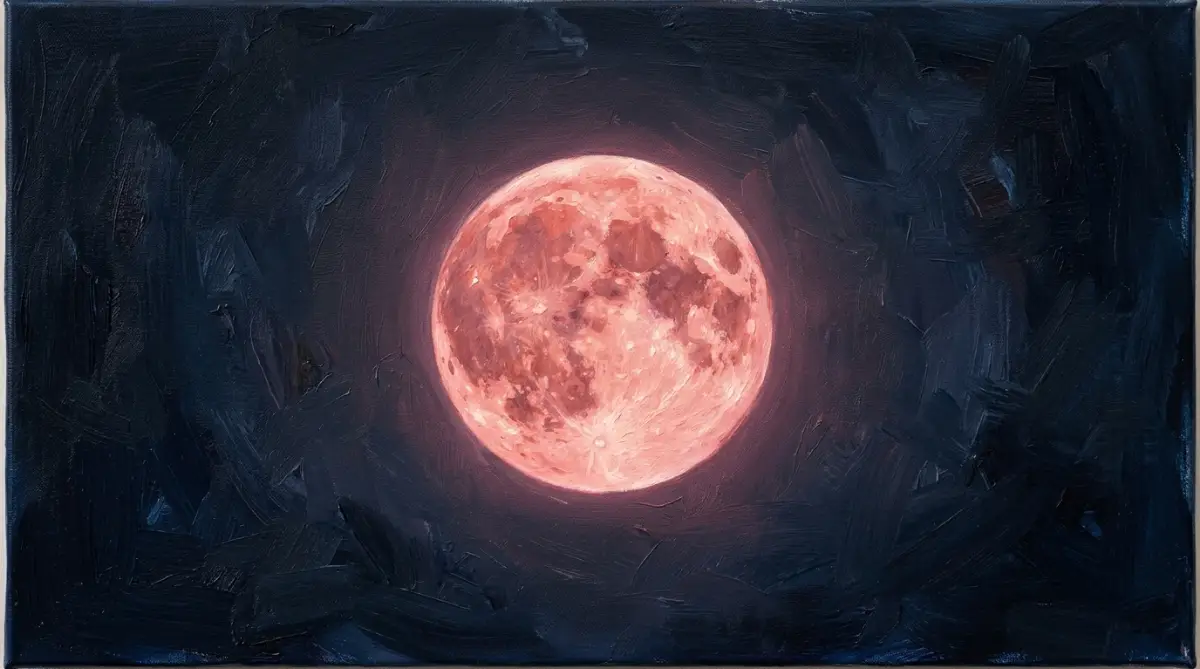
Quick Facts about the Pink Moon
- Pink Moon Date: Thursday, April 2, 2026
- Peak illumination: 02:11 UTC
- Traditional Name: Pink Moon
- Named After: Pink phlox flowers that bloom in spring
- Moon Sign: Libra
- Best viewing: Around 30 minutes after sunset, with a clear horizon toward the east.
- Other names: Breaking Ice Moon, Egg Moon, Paschal Moon, Budding Moon, Seed Moon, Awakening Moon, Moon of the Red Grass Appearing
The April Full Moon is traditionally known as the Pink Moon, a name linked to the blooming of pink phlox flowers in parts of North America during spring. In 2026, the Pink Moon reaches peak illumination on April 2 at 02:11 UTC. Despite its name, the Moon does not actually turn pink. April also brings the Lyrid meteor shower, close encounters between the Moon and several bright objects, and a favorable period for observing Earthshine.
For upcoming Full Moon dates, see the Full Moon Calendar.
When is the Pink Moon 2026?
The Pink Moon reaches full phase on Thursday, April 2, 2026, at 02:11 UTC.
The exact local date and time depend on your time zone. In India, the Full Moon reaches peak illumination at approximately 7:41 AM IST on April 2.
Because the exact peak occurs during daylight hours in India, the Moon will not be at its fullest appearance from most locations at that moment. It will still look essentially full on the evening of April 1 and the evening of April 2.
You can check the Moon’s exact details for April 2, including illumination, Moon age, distance from Earth, azimuth, and other lunar data, on Moon Age Today.
Why Is It Called the Pink Moon?
The name Pink Moon is associated with the blooming of pink phlox flowers in North America during early spring. The flowers, sometimes called moss pink, commonly bloom around the time of April’s full moon.
The name does not describe the Moon’s actual color. Under normal conditions, the Moon retains its usual gray-white color.
Other April Full Moon names reflect seasonal changes, including melting ice, emerging plants, eggs, and the return of spring growth.
How to watch the Pink Moon
The Pink Moon is bright enough to observe without a telescope.
- Find a location with a clear view toward the eastern horizon.
- Look shortly after sunset as the full moon rises.
- Choose an area away from tall buildings, trees, and hills.
- Binoculars can reveal craters and other lunar surface features.
- A telescope will provide a closer view of the lunar surface.
- For photography, include trees, buildings, or mountains in the foreground.
For exact local moonrise and moonset times, use the Moonrise & Moonset Time Calculator.
Why can the Pink Moon look orange or yellow?
Although the Pink Moon is not actually pink, it can appear yellow, orange, or reddish when it is close to the horizon.
When the Moon is low in the sky, its light passes through a greater amount of Earth’s atmosphere before reaching an observer. Atmospheric scattering reduces the amount of shorter blue wavelengths reaching the eye directly, making warmer colors more noticeable.
Dust, smoke, haze, and pollution can make these colors stronger.
What are the other names of the April full moon?
The April full moon has several traditional names associated with spring and seasonal changes.
- Breaking Ice Moon: Refers to the melting of winter ice.
- Egg Moon: Associated with eggs and spring nesting.
- Paschal Moon: Connected with the calculation of Easter in the Christian calendar.
- Budding Moon: Refers to plants beginning to develop new growth.
- Seed Moon: Associated with spring planting.
- Awakening Moon: Describes the return of plant and animal activity after winter.
- Moon of the Red Grass Appearing: A seasonal reference to emerging vegetation.
These names come from different cultural and regional traditions and were not used universally.
Is the Pink Moon a supermoon?
No. The April 2026 Pink Moon is not a supermoon.
A supermoon occurs when a full moon happens close to the moon’s perigee, the closest point to Earth in its elliptical orbit.
The Pink Moon’s apparent size is not significantly larger than an average full moon.
Lunar Eclipse
There is no lunar eclipse during the April 2026 Pink Moon.
You can track upcoming lunar eclipses with the Lunar Eclipse Calendar.
Moon Phases for April 2026
| Phase | Date |
|---|---|
| Full Moon 🌕 | April 2 |
| Last Quarter 🌗 | April 10 |
| New Moon 🌑 | April 17 |
| First Quarter 🌓 | April 24 |
The Full Moon occurs on April 2 at approximately 02:11 UTC, the Last Quarter on April 10 at approximately 04:51 UTC, the New Moon on April 17 at approximately 11:51 UTC, and the First Quarter on April 24 at approximately 02:31 UTC.
To follow the moon’s daily phases throughout April, use the Moon Phase Calendar.
Other Must-Watch Sky events in April 2026
- Mercury at greatest western elongation, April 3: Mercury reaches its greatest elongation west of the Sun, providing a favorable opportunity to observe the planet in the morning sky.
- Moon and Antares, April 6: The Moon passes close to Antares, the bright reddish star marking the heart of Scorpius.
- New Moon, April 17: The dark sky around the New Moon provides favorable conditions for observing faint stars and deep-sky objects.
- Moon, Venus and Pleiades, April 18: A thin waxing crescent The moon appears close to bright Venus and the Pleiades star cluster in the evening sky.
- Moon and Jupiter, April 22: The Moon passes close to Jupiter in the evening sky. The bright stars Pollux and Castor in Gemini can also be seen nearby.
- Lyrid Meteor Shower, April 22 to 23: The Lyrids reach their annual peak around April 22 to 23. The shower is active from approximately April 14 to 30 and is one of the oldest known meteor showers.
- Moon and Regulus, April 25: The Moon passes close to Regulus, the brightest star in Leo.
- Pink Moon, April 2: The Full Moon reaches peak illumination at 02:11 UTC and becomes April’s Pink Moon.
Sources
- NASA SkyCal: 2026 Sky Events
- Time and date: The Moon in April 2026
- Time and date: Pink Moon
- NASA Daily Moon Guide
Note: All dates and times in this article are given in UTC unless otherwise stated. Local moonrise, moonset, and visibility vary by location.
Leave a Reply