
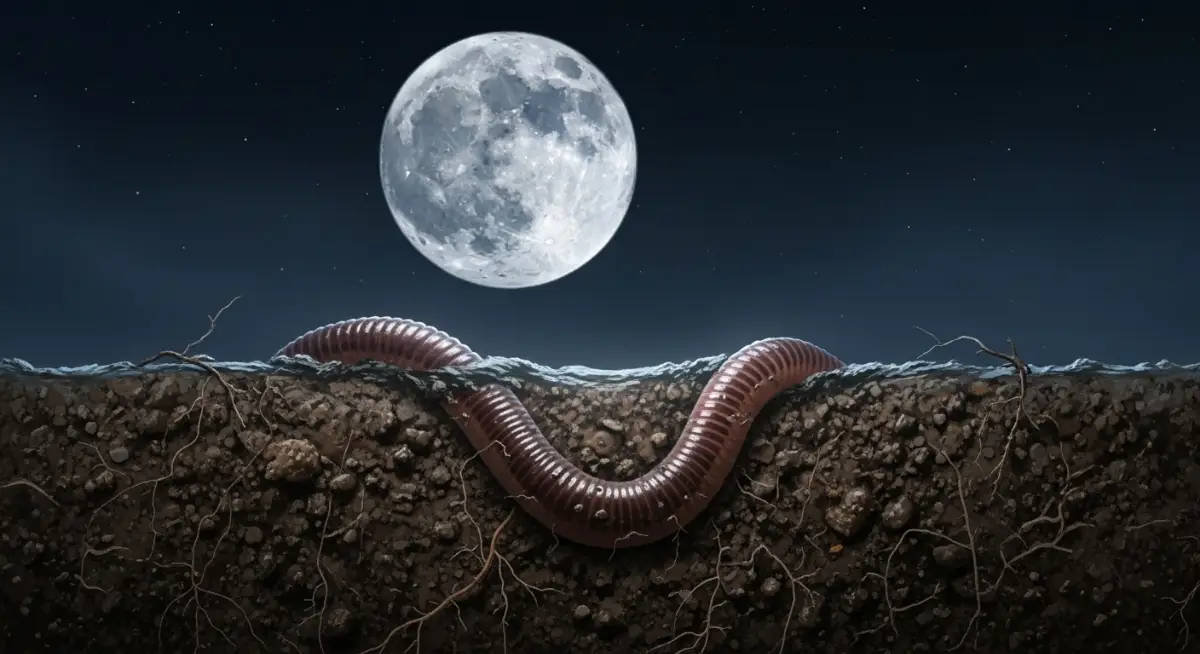
Quick Facts about the Worm Moon
- Worm Moon Date: Tuesday, March 3, 2026
- Peak illumination: 11:38 UTC
- Traditional Name: Worm Moon
- Named After: Earthworms becoming active as soil warms in early spring
- Moon Sign: Virgo
- Best viewing: Around 30 minutes after sunset, with a clear view toward the eastern horizon.
- Other names: Crow Moon, Lenten Moon, Crust Moon, Sap Moon, Sugar Moon, Chaste Moon
The March full moon is traditionally known as the Worm Moon, a name associated with the return of earthworm activity as winter ends and the soil begins to warm. In 2026, the Worm Moon reaches peak illumination on March 3 at 11:38 UTC and coincides with a total lunar eclipse. The eclipse turns the full moon a deep reddish-orange during totality, making the March full moon one of the year’s major lunar events.
For upcoming Full Moon dates, see the Full Moon Calendar.
When is the Worm Moon 2026?
The Worm Moon reaches full phase on Tuesday, March 3, 2026, at 11:38 UTC.
The exact local date and time depend on your time zone. In India, the Full Moon reaches peak illumination at approximately 5:08 PM IST on March 3.
The Moon will already be below the horizon in many parts of India when the eclipse reaches its global maximum. As the Moon rises in the east, observers across much of India can see the later stages of the eclipse. The total phase is visible from some northeastern parts of India and the Andaman and Nicobar Islands.
You can check the Moon’s exact details for March 3, including illumination, Moon age, distance from Earth, azimuth, and other lunar data, on Moon Age Today.
Why Is It Called the Worm Moon?
The name “Worm Moon” refers to the earthworms that begin appearing as soil warms during the transition from winter to spring.
Earthworms become more active when temperatures and soil conditions become suitable. Their activity brings them closer to the surface, where they become an important food source for birds.
The name is one of several traditional names associated with March’s full moon. Different cultures used seasonal indicators such as animal activity, changing weather, and plant growth to mark this time of year.
How to watch the Worm Moon
The Worm Moon can be observed without special equipment.
- Find a location with a clear view toward the eastern horizon.
- Look toward the east as the Moon rises after sunset.
- Choose an area away from tall buildings, trees, and hills.
- Binoculars can reveal craters and other lunar surface features.
- During the eclipse, watch for the Moon to develop a reddish-orange color.
- For photography, include buildings, trees, or mountains in the foreground.
For exact local moonrise and moonset times, use the Moonrise & Moonset Time Calculator.
Why does the Worm Moon turn red in 2026?
The 2026 Worm Moon turns reddish because it passes through Earth’s shadow during a total lunar eclipse.
As Earth moves directly between the Sun and Moon, Earth blocks direct sunlight from reaching the lunar surface. Some sunlight still passes through Earth’s atmosphere, where it is filtered and bent toward the Moon.
The atmosphere scatters much of the blue light while allowing more red and orange wavelengths to pass through. This gives the eclipsed Moon its characteristic reddish appearance.
What is a Worm Moon?
The Worm Moon is simply the traditional name for the March Full Moon. It is not a different astronomical type of Moon.
The moon follows the same orbital cycle throughout the year, and its full moon phase occurs when the lunar disk is fully illuminated from Earth’s perspective.
The name describes the season in which the full moon occurs rather than a physical change in the moon itself.
Other Traditional Names of the March Full Moon
The March Full Moon has several traditional names associated with the transition from winter to spring.
- Crow Moon: Associated with the return of crows and the end of winter.
- Lenten Moon: Connected with the Christian season of Lent.
- Crust Moon: Refers to the crust that forms over snow as it freezes and thaws.
- Sap Moon: Associated with the seasonal flow of tree sap.
- Sugar Moon: Connected with maple sugaring season.
- Chaste Moon: A traditional European name associated with March.
- Wind Moon: Refers to the strong winds that can occur during early spring.
These names come from different cultural and regional traditions and were not used universally.
Lunar Eclipse March 2026
Yes. The March 2026 Worm Moon coincides with a total lunar eclipse on March 3.
During a total lunar eclipse, the entire Moon passes through Earth’s darkest central shadow, known as the umbra. The Moon can take on a deep red or orange color during totality.
NASA lists the global maximum of the eclipse at approximately 11:35 UTC, with the full moon occurring at approximately 11:38 UTC.
March 3, 2026, Lunar Eclipse Timeline
| Eclipse stage | UTC |
|---|---|
| The penumbral eclipse begins | 08:44 UTC |
| A partial eclipse begins | 09:50 UTC |
| The total eclipse begins | 10:54 UTC |
| Maximum eclipse | 11:35 UTC |
| The total eclipse ends | 12:42 UTC |
| The partial eclipse ends | 13:47 UTC |
| The penumbral eclipse ends | 14:53 UTC |
The total eclipse is visible in the evening from eastern Asia and Australia, throughout the night across the Pacific, and during the early morning from North and Central America and parts of western South America. The eclipse is partial in Central Asia and much of South America. It is not visible from Africa or Europe.
In India, much of the eclipse occurs before moonrise. Most locations can observe the ending stages after the Moon rises, while some northeastern regions and the Andaman and Nicobar Islands can see part of totality.
For eclipse dates and visibility information, visit the Lunar Eclipse Calendar.
Moon Phases for March 2026
| Phase | Date |
|---|---|
| Full Moon 🌕 | March 3 |
| Last Quarter 🌗 | March 11 |
| New Moon 🌑 | March 19 |
| First Quarter 🌓 | March 25 |
The Full Moon occurs on March 3 at approximately 11:38 UTC, the last quarter on March 11 at approximately 09:39 UTC, the New Moon on March 19 at approximately 01:23 UTC, and the first quarter on March 25 at approximately 19:18 UTC.
To follow the moon’s daily phases throughout March, use the Moon Phase Calendar.
Other Must-Watch Sky events in March 2026
- Total Lunar Eclipse, March 3: The year’s first lunar eclipse occurs during the Worm Moon. The Moon turns reddish-orange during totality.
- Moon and Spica, March 6: The Moon passes close to Spica, the brightest star in the constellation Virgo.
- Moon and Antares, March 10: The waning Moon passes close to Antares, the bright red star in Scorpius.
- New Moon, March 19: The dark lunar sky provides favorable conditions for observing faint stars and deep-sky objects.
- March Equinox, March 20: The vernal equinox occurs at approximately 14:46 UTC, marking the beginning of astronomical spring in the Northern Hemisphere and autumn in the Southern Hemisphere.
- Moon and Venus, March 20: A thin crescent Moon appears close to bright Venus around the time of the March equinox.
- Moon and Pleiades, March 23: The Moon passes close to the Pleiades star cluster, creating a notable pairing in the evening sky.
- Moon and Jupiter, March 26: The Moon passes close to Jupiter in the evening sky.
- Moon and Beehive Cluster, March 28: The Moon passes near the Beehive Cluster, also known as M44, in the constellation Cancer.
- Worm Moon, March 3: The Full Moon reaches peak illumination at 11:38 UTC and becomes the March Full Moon of 2026.
Sources
- NASA SkyCal: 2026 Sky Events
- NASA: March 2026 Total Lunar Eclipse
- Time and date: Worm Moon
- India Meteorological Department: March 3, 2026 Total Lunar Eclipse
Note: All dates and times in this article are given in UTC unless otherwise stated. Local moonrise, moonset, and eclipse visibility vary by location.
Leave a Reply