
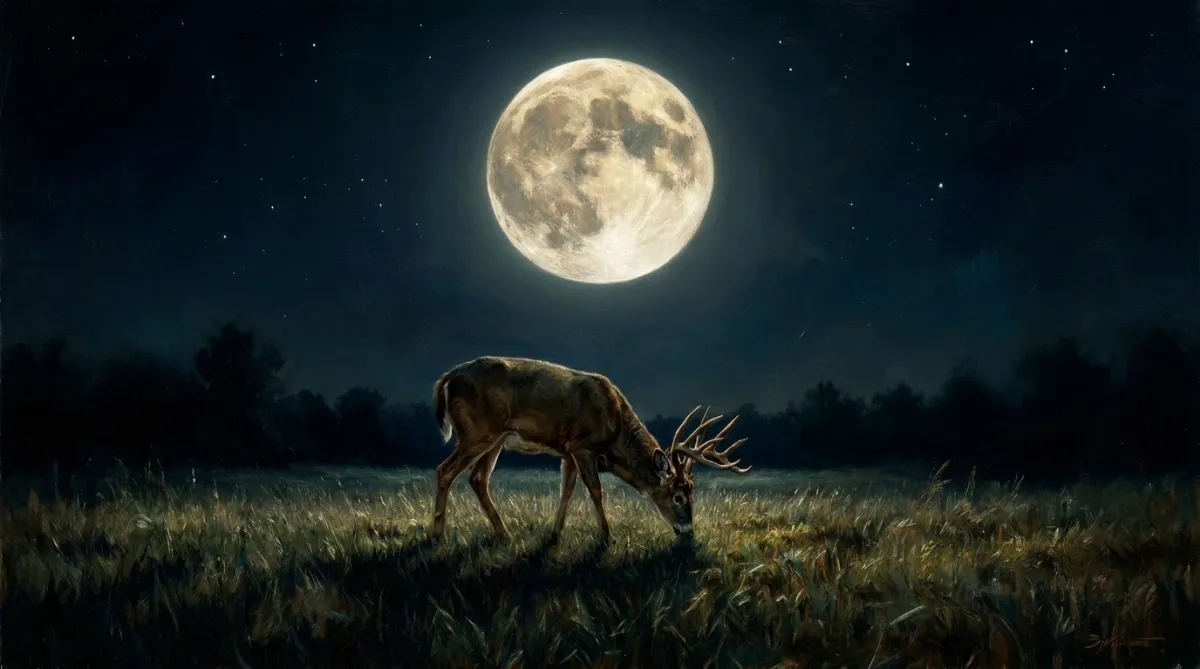
Quick Facts about the buck Moon
- Buck Moon Date: Wednesday, July 29, 2026
- Peak illumination: 14:36 UTC
- Traditional Name: Buck Moon
- Named After: The new antlers growing on male deer
- Moon Sign: Aquarius
- Best viewing: Around 30 minutes after sunset on July 29, with a clear horizon toward the southeast.
- Other names: Thunder Moon, Hay Moon, Mead Moon, Salmon Moon, Raspberry Moon, Wyrt Moon
The July Full Moon is traditionally known as the Buck Moon because male deer grow new antlers during this part of the year. In 2026, the Full Moon reaches peak illumination on July 29 at about 14:36 UTC.
The Moon will appear full on the nights around the peak, making the evening of July 29 a good opportunity for observation. July also brings several close moon and planet pairings, along with the peak of the Southern Delta Aquariids and Alpha Capricornids meteor showers.
For upcoming Full Moon dates, see the Full Moon Calendar.
When is the Buck Moon 2026?
The Buck Moon reaches full phase on Wednesday, July 29, 2026, at approximately 14:36 UTC.
The exact local date and time depend on your time zone. In India, the Full Moon reaches peak illumination at approximately 8:06 PM IST on July 29.
The Moon will be below the horizon for many locations at the exact moment of peak illumination. It will still appear essentially full when it rises that evening.
You can check the Moon’s exact details for July 29, including illumination, Moon age, distance from Earth, azimuth, and other lunar data, on Moon Age Today.
Why Is It Called the Buck Moon?
The name “Buck Moon” refers to the annual growth of new antlers on male deer, or bucks.
Male deer shed their previous antlers each year and begin growing a new set during spring and summer. By July, the new antlers are rapidly developing and are covered by a layer of living tissue called velvet.
The Buck Moon name was recorded in North American traditions, including by Captain Jonathan Carver during his travels in the 1760s. The name is one of several traditional names associated with July’s full moon.
How to watch the Buck Moon
The Buck Moon can be observed with the naked eye.
- Find a location with a clear view toward the southeast horizon.
- Look shortly after sunset as the Moon begins to rise.
- Choose a location away from tall buildings, trees, and hills.
- Binoculars can reveal lunar craters and bright and dark regions on the surface.
- A telescope will provide a more detailed view of lunar features.
- For photography, use foreground objects such as trees, buildings, or mountains to frame the Moon.
For exact local moonrise and moonset times, use the Moonrise & Moonset Time Calculator.
What happens to a buck’s antlers in July?
Male deer grow a new set of antlers every year.
Antler growth begins soon after the previous antlers are shed. During the growing period, antlers are covered in velvet, a layer of skin containing blood vessels and nerves that supplies oxygen and nutrients to the developing bone.
Antlers grow rapidly during summer and eventually harden as mineralization progresses. Once growth is complete, the velvet dries and is rubbed away.
The timing varies by species, age, and geographic location, but July is an important part of the antler-growth period for many North American deer.
Some amazing facts about deer antlers
1. Antlers are bone.
They are among the fastest-growing types of bone tissue found in mammals.
2. They grow every year.
Unlike permanent horns, antlers are shed and regrown annually by many deer species.
3. Growth can be extremely rapid.
During peak development, antlers can grow several centimeters in a week.
4. Velvet supplies nutrients.
Blood vessels within the velvet support the rapid growth of the developing antler.
5. Antlers harden before the breeding season.
As growth ends, the antler structure mineralizes and becomes hard.
6. Antlers are mainly used by males.
In most deer species, males grow antlers that are used in competition and displays during the breeding season.
7. Antlers can reveal a deer’s age and condition.
Size and structure are influenced by genetics, nutrition, age, and environmental conditions.
Other Traditional Names of the July Full Moon
The July Full Moon has several traditional names connected with animals, plants, weather, and seasonal activities.
- Thunder Moon: Associated with frequent summer thunderstorms.
- Hay Moon: Connected with the summer hay harvest.
- Mead Moon: Associated with the production of mead.
- Salmon Moon: A Tlingit name connected with the seasonal return and harvesting of salmon.
- Raspberry Moon: Associated with the ripening of raspberries.
- Berry Moon: Connected with seasonal berry harvesting.
- Moon When the Chokecherries Are Ripe: A Dakota name describing the seasonal ripening of chokecherries.
- Month of the Ripe Corn Moon: A Cherokee seasonal name associated with corn.
- Feather Moulting Moon: A Cree name referring to the seasonal molting of birds.
- Wyrt Moon: Associated with herbs and plants.
These names come from different cultural and regional traditions and were not used universally.
Lunar Eclipse Details (If any)
There is no lunar eclipse during the July 2026 Buck Moon.
The July Full Moon does not pass through Earth’s shadow because the Moon is not sufficiently close to the orbital node where the Moon’s orbit crosses the plane of Earth’s orbit.
The next major lunar eclipse after the Buck Moon occurs on August 28, 2026, when the Sturgeon Moon coincides with a deep partial lunar eclipse.
You can track upcoming lunar eclipses with the Lunar Eclipse Calendar.
Moon Phases for July 2026
| Phase | Date |
|---|---|
| Last Quarter 🌗 | July 7 |
| New Moon 🌑 | July 14 |
| First Quarter 🌓 | July 21 |
| Full Moon 🌕 | July 29 |
The Last Quarter occurs on July 7 at approximately 19:29 UTC, the New Moon on July 14 at approximately 09:43 UTC, the First Quarter on July 21 at approximately 11:05 UTC, and the Full Moon on July 29 at approximately 14:35 to 14:36 UTC.
To follow the moon’s daily phases throughout July, use the Moon Phase Calendar.
Other Must-Watch Sky events in July 2026
- Mars and Uranus, July 4: Mars and Uranus appear close together in the sky, with the Pleiades star cluster nearby. Uranus requires binoculars or a telescope under suitable conditions.
- Earth at Aphelion, July 6: Earth reaches aphelion, the point in its orbit when it is farthest from the Sun.
- Moon and Saturn, July 7: The Last Quarter Moon passes close to Saturn in the morning sky.
- Moon, Mars, and Pleiades, July 11: A waning crescent Moon appears close to Mars and the Pleiades star cluster before sunrise.
- Moon and Venus, July 17: A thin crescent Moon passes close to bright Venus shortly after sunset.
- Southern Delta Aquariids, July 30: The meteor shower reaches peak activity around July 30 to 31. The nearly full moon will significantly reduce visibility of the fainter meteors in 2026.
- Alpha Capricornids, July 30 to 31: This meteor shower also reaches its peak around the end of July. It is known for producing occasional bright fireballs, although the bright full moon will interfere with observations in 2026.
- Buck Moon, July 29: The full moon reaches peak illumination at approximately 14:36 UTC and will rise after sunset as a bright summer full moon.
Sources
- Time and date: The Moon in July 2026
- The Old Farmer’s Almanac: July 2026 Full Buck Moon
- American Meteor Society: July 2026 Meteor Activity
- Farmers’ Almanac: Buck Moon 2026
Note: All dates and times in this article are given in UTC unless otherwise stated. Local moonrise, moonset, and visibility vary by location.
Leave a Reply