
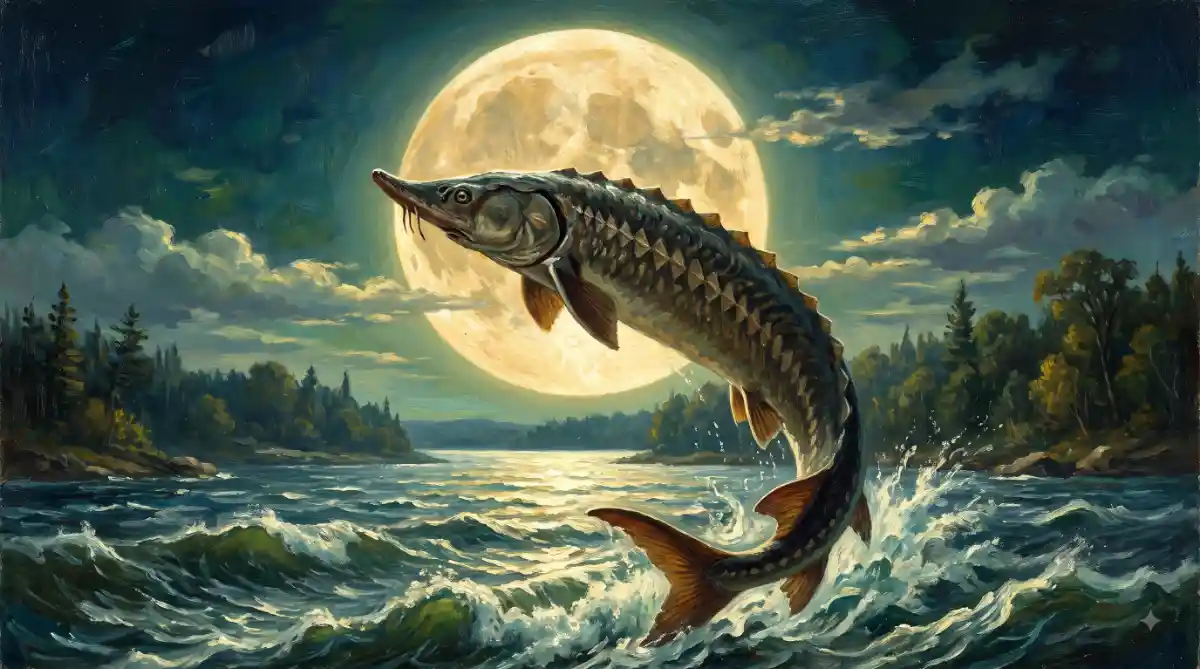
Quick Facts about the Sturgeon Moon
- Sturgeon Moon Date: Friday, August 28, 2026
- Peak illumination: 04:19 UTC
- Traditional Name: Sturgeon Moon
- Named After: The late-summer sturgeon fishing season
- Moon Sign: Pisces
- Best viewing: Around 30 minutes after sunset on the night of peak, with a clear horizon to the east.
- Other names: Grain Moon, Green Corn Moon, Red Moon, Lightning Moon, Wyrt Moon, Black Cherries Moon
The August Full Moon, known as the Sturgeon Moon, reaches peak illumination on August 28, 2026. The name comes from the sturgeon fishing season traditionally associated with late summer around the Great Lakes and Lake Champlain.
The 2026 Sturgeon Moon is especially notable because it coincides with a deep partial lunar eclipse, during which about 96% of the Moon’s disk enters Earth’s umbra. August also features the Perseid meteor shower and a total solar eclipse earlier in the month.
For a complete list of upcoming Full Moons, see the Full Moon Calendar.
When is the Sturgeon Moon 2026?
The Sturgeon Moon reaches its full phase on Friday, August 28, 2026, at 04:19 UTC.
The exact local date and time vary by time zone. In India, the Full Moon occurs during the morning of August 28, making the evenings of August 27 and August 28 good opportunities to see the nearly full Moon.
A full moon occurs when Earth lies approximately between the Sun and Moon, with the lunar hemisphere facing Earth fully illuminated by sunlight.
You can also check the Moon’s exact details for August 28, including illumination, Moon age, distance from Earth, azimuth, and other lunar data, on Moon Age Today.
Why Is It Called the Sturgeon Moon?
The name “Sturgeon Moon” comes from the sturgeon fishing season traditionally associated with August around the Great Lakes and Lake Champlain.
Sturgeon were an important food source for Indigenous communities in the region, and late summer was a productive period for catching these large freshwater fish. The name was later recorded in European and colonial accounts.
The name is seasonal rather than astronomical. Other communities used different names for the August Full Moon based on local plants, crops, animals, and weather.
How to watch the Sturgeon Moon
The Sturgeon Moon is visible without special equipment.
- Find a location with a clear view toward the eastern horizon.
- Check your local moonrise time before heading outside.
- Look shortly after sunset when the moon begins rising.
- Choose a darker location for a better view of the surrounding stars.
- Use binoculars to see lunar craters and surface features.
- A camera or smartphone can capture the Moon alongside buildings, trees, or landscapes.
For your exact local Moonrise and Moonset times, use the Moonrise & Moonset Time Calculator.
What is a sturgeon?
Sturgeons are ancient freshwater and coastal fish belonging to the family Acipenseridae.
Their evolutionary lineage dates back more than 120 million years. Sturgeons have long bodies, rows of bony plates called scutes, and four sensory barbels near the mouth.
Their skeletons are composed largely of cartilage, and they do not have teeth. Many species feed along river and lake bottoms by using their barbels to locate food.
Several sturgeon species migrate between freshwater and marine environments. Many populations have declined because of overfishing, habitat loss, pollution, and disrupted migration routes.
Some amazing facts about a Sturgeon
1. They are ancient fish.
Sturgeons have existed for more than 120 million years.
2. Some species grow very large.
Atlantic sturgeon can reach around 14 feet in length.
3. They have no teeth.
Sturgeons use their barbels to locate food and suck it into their mouths.
4. Their skeleton is mostly cartilage.
Their body structure differs from that of most familiar bony fish.
5. Some species live for decades.
Atlantic sturgeon can live for more than 50 years.
6. They migrate to reproduce.
Several species return to freshwater rivers to spawn.
7. Many species are threatened.
Overfishing, habitat degradation, pollution, and dams have affected sturgeon populations worldwide.
Other Traditional Names of the August Full Moon
The August Full Moon has several traditional names from different cultures and regions.
- Grain Moon: Associated with ripening grain.
- Green Corn Moon: Connected with developing corn crops.
- Red Moon: Associated with the reddish appearance of the Moon near the horizon.
- Lightning Moon: Linked to late-summer thunderstorms.
- Wyrt Moon: Associated with herbs and plants.
- Black Cherries Moon: Connected with seasonal berries.
- Corn Moon: Used in some traditions to mark the development of corn.
- Ricing Moon: Associated with wild rice harvesting.
- Flying Up Moon: A seasonal reference to young birds becoming capable of flight.
These names are not universal. Different Indigenous nations and communities developed their own lunar naming traditions based on their local environment and seasonal cycles.
Lunar Eclipse August 2026
A deep partial lunar eclipse occurs on August 28, 2026, on the same date as the Sturgeon Moon.
At maximum eclipse, approximately 96.2% of the Moon’s disk will be inside Earth’s umbra. Because a small portion remains outside the umbra, the event is classified as a partial rather than total lunar eclipse.
August 28, 2026 Lunar Eclipse Timeline
| Eclipse stage | Time |
|---|---|
| Penumbral eclipse begins | 01:24 UTC |
| Partial eclipse begins | 02:34 UTC |
| Maximum eclipse | 04:13 UTC |
| Partial eclipse ends | 05:52 UTC |
| Penumbral eclipse ends | 07:02 UTC |
The eclipse will be visible from parts of North America, South America, Europe, and Africa, depending on local conditions and the Moon’s position above the horizon.
During the eclipse, the Moon can appear orange or reddish as sunlight passing through Earth’s atmosphere reaches the lunar surface.
For upcoming lunar eclipse dates and visibility information, visit the Lunar Eclipse Calendar.
Moon Phases for August 2026
| Phase | Date |
|---|---|
| Last Quarter 🌗 | August 6 |
| New Moon 🌑 | August 12 |
| First Quarter 🌓 | August 20 |
| Full Moon 🌕 | August 28 |
The New Moon occurs on August 12 at approximately 17:37 UTC, the First Quarter on August 20 at approximately 02:46 UTC, and the Full Moon on August 28 at approximately 04:19 UTC.
To explore the Moon’s phases throughout August and the rest of the year, use the Moon Phase Calendar.
Other Must-Watch Sky events in August 2026
- Total Solar Eclipse, August 12: A total solar eclipse crosses parts of Greenland, Iceland, and Spain, while a partial eclipse is visible across a much wider region.
- Perseid Meteor Shower, August 12 to 13: The Perseids reach their annual peak around August 12 and 13. The New Moon creates dark skies that are favorable for meteor watching.
- New Moon, August 12: The dark lunar sky provides good conditions for observing faint stars and meteors.
- First Quarter Moon, August 20: The half-illuminated Moon provides excellent conditions for observing craters along the lunar terminator.
- Sturgeon Moon and Partial Lunar Eclipse, August 28: The full moon coincides with a deep partial lunar eclipse, making it the month’s major lunar event.
Sources
- NASA Eclipse Predictions
- Time and date: August 28, 2026 Lunar Eclipse
- NOAA Fisheries: Atlantic Sturgeon
- The Old Farmer’s Almanac: August Full Moon
Note: All dates and times in this article are given in UTC unless otherwise stated. Local moonrise, moonset, and eclipse visibility vary by location.
Leave a Reply