
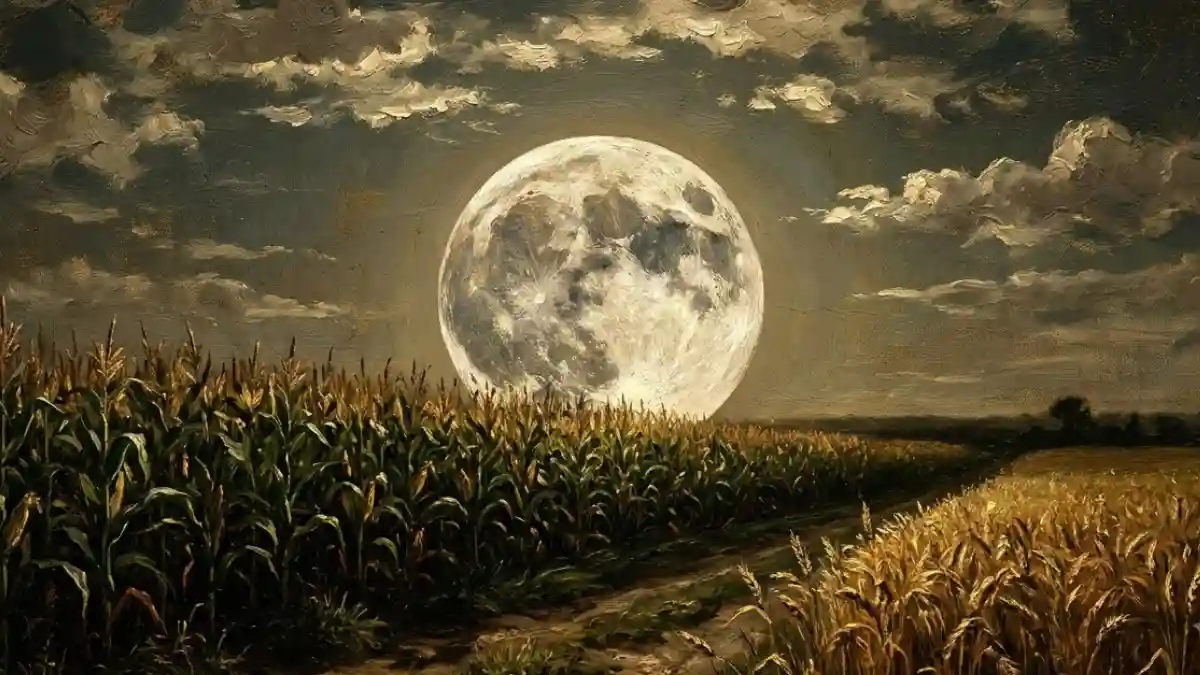
Quick Facts about the Harvest Moon
- Harvest Moon Date: Saturday, September 26, 2026
- Peak illumination: 16:49 UTC
- Traditional Name: Harvest Moon
- Named After: The Full Moon closest to the autumnal equinox
- Moon Sign: Aries
- Best viewing: Around 30 minutes after sunset, with a clear horizon toward the east.
- Other names: Corn Moon, Barley Moon, Fruit Moon, Fruit Harvest Moon
The September Full Moon is known as the Harvest Moon in 2026 because it is the Full Moon closest to the September equinox. It reaches peak illumination on September 26 at 16:49 UTC, just three days after the September equinox. The Harvest Moon has a long connection with agriculture because its bright evening light traditionally gave farmers extra time to work in the fields during the harvest season.
For upcoming Full Moon dates, see the Full Moon Calendar.
When is the Harvest Moon in 2026?
The Harvest Moon reaches full phase on Saturday, September 26, 2026, at 16:49 UTC.
The Full Moon occurs only three days after the September equinox, which takes place on September 23, 2026, at 00:05 UTC.
In India, the September Full Moon occurs at approximately 10:19 PM IST on September 26.
You can check the Moon’s exact details for September 26, including illumination, Moon age, distance from Earth, azimuth, and other lunar data, on Moon Age Today.
Why Is It Called the Harvest Moon?
The harvest moon is the traditional name given to the full moon closest to the autumnal equinox.
Unlike most Full Moon names, the Harvest Moon does not always occur in September. Depending on the year, the full moon closest to the September equinox can fall in late September or early October.
The name is closely linked to agriculture. Before widespread electric lighting, the bright moon provided additional natural light during the evening, allowing farmers to continue harvesting crops after sunset.
The September Full Moon is also associated with the gathering of crops such as corn, pumpkins, squash, beans, and wild rice in parts of North America.
How to watch the Harvest Moon
The Harvest Moon is easy to observe without a telescope.
- Find a location with a clear view toward the eastern horizon.
- Look for the moon shortly after sunset as it rises.
- Choose an area away from tall buildings, hills, and trees.
- A darker location will provide a better view of the surrounding night sky.
- Binoculars can reveal lunar craters and surface features.
- For photography, include foreground objects such as buildings, trees, or mountains.
For exact local moonrise and moonset times, use the Moonrise & Moonset Time Calculator.
What makes the Harvest Moon different?
The Harvest Moon is associated with a shorter interval between successive moonrises around the time of the September equinox.
Normally, the moon rises roughly 50 minutes later each day on average. Around the Harvest Moon, the difference can be significantly smaller at mid-northern latitudes.
This effect means the Moon rises relatively soon after sunset on several consecutive evenings, producing a series of bright early-evening Moon appearances. That pattern was useful to farmers harvesting crops after sunset.
The effect is less pronounced near the equator and varies with latitude.
Why does the Harvest Moon look orange?
The Harvest Moon can appear orange, yellow, or reddish when it is close to the horizon.
This happens because moonlight travels through a greater amount of Earth’s atmosphere when the moon is low in the sky. Atmospheric particles scatter shorter wavelengths of light more strongly, allowing more reddish and orange light to reach an observer.
Dust, smoke, haze, and pollution can make the color more noticeable.
Other Traditional Names of the September Full Moon
The September Full Moon has several traditional names connected with crops and the changing season.
- Corn Moon: Associated with corn reaching maturity and becoming ready for harvest.
- Barley Moon: Linked to the harvesting of barley.
- Fruit Moon: Connected with fruit becoming ripe during late summer.
- Fruit Harvest Moon: A seasonal name associated with gathering ripe fruit.
- Harvest Moon: Refers specifically to the full moon closest to the autumnal equinox.
The use of full moon names varies between cultures and regions. These names should not be treated as universal names used by every Indigenous community.
Lunar Eclipse
There is no lunar eclipse during the September 2026 full moon.
You can track upcoming lunar eclipses with the Lunar Eclipse Calendar.
Moon Phases for September 2026
| Phase | Date |
|---|---|
| Last Quarter 🌗 | September 4 |
| New Moon 🌑 | September 11 |
| First Quarter 🌓 | September 18 |
| Full Moon 🌕 | September 26 |
The Last Quarter occurs on September 4 at approximately 07:51 UTC, the New Moon on September 11 at approximately 03:27 UTC, the First Quarter on September 18 at approximately 20:44 UTC, and the Full Moon on September 26 at approximately 16:49 UTC.
To follow the moon’s daily phases throughout September, use the Moon Phase Calendar.
Other Must-Watch Sky events in September 2026
- Pleiades and Moon, September 3: The Moon passes close to the Pleiades star cluster, creating a notable pairing for early-morning or nighttime observers.
- Moon at Perigee, September 6: The Moon reaches perigee, the closest point to Earth in its orbit, at approximately 368,255 km.
- Moon and Jupiter, September 8: The Moon passes close to Jupiter, creating a bright planetary pairing in the sky.
- September New Moon, September 11: The absence of bright moonlight provides darker skies for observing stars and other faint celestial objects.
- Moon and Venus, September 14: The thin lunar crescent passes close to bright Venus, producing a striking early-evening conjunction.
- First Quarter Moon, September 18: The half-illuminated moon provides good conditions for observing lunar craters along the terminator.
- September Equinox, September 23: The September equinox occurs at 00:05 UTC, marking the astronomical beginning of autumn in the Northern Hemisphere and spring in the Southern Hemisphere.
- Neptune at Opposition, September 26: Neptune reaches opposition on September 26, placing the planet opposite the sun in Earth’s sky and making it well positioned for observation with suitable equipment.
- Harvest Moon, September 26: The Full Moon reaches peak illumination at 16:49 UTC, becoming the September Full Moon and the 2026 Harvest Moon.
Sources
- NASA SkyCal: 2026 Sky Events
- NASA Science: September Equinox 2026
- Time and date: Harvest Moon 2026
- Space.com: Full Moon Calendar 2026
Note: All dates and times in this article are given in UTC unless otherwise stated. Local moonrise, moonset, and visibility vary by location.
Leave a Reply